
Laser Protective Lens Size Chart: Fit Is D×T, Life Is Thickness
The two numbers, and which one bites
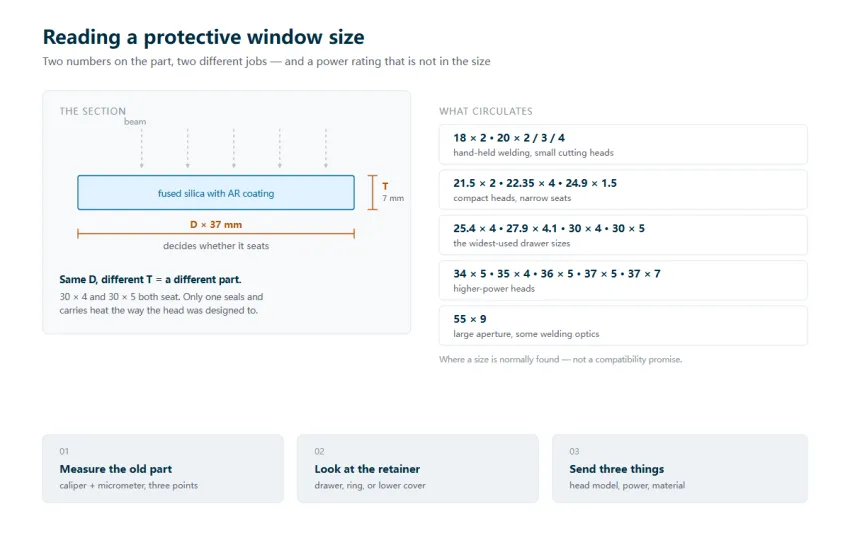
A laser protective lens size chart is short, because the part only carries two numbers: outside diameter and thickness. Diameter decides whether the window sits in the seat. Thickness decides how long it survives there. Coating, substrate and edge finish are invisible in the size, which is why two windows measuring the same can behave nothing alike.
The convention is D × T in millimetres: 37 × 7 means 37 mm across and 7 mm thick. Some listings write “37×7–12kW”, as though the power rating were part of the dimension. It is not. The head fixes the size; the power figure is a claim about the coating and the substrate, and every supplier states it differently — more on that below.
There is no universal part number
A nozzle can be ordered by bore and thread. A protective window usually cannot. Brands use their own codes, and two head families can take the same 30 × 5 window through completely different retaining hardware. That is the reason a size chart has to be read as “what exists in the field”, not as “what your machine needs”.
What values actually circulate
The table below collects sizes that appear repeatedly across head families. The grouping follows the power band a size is normally found in. Read the last column before the second: the group tells you where to look, not what you have.
| Size (D × T, mm) | Where it normally appears | What is different about it | What to confirm |
|---|---|---|---|
| 18 × 2 | Hand-held welding guns, small marking heads | The smallest window in common use; very little thermal mass | Old part under a micrometer; welding gun model |
| 20 × 2 / 20 × 3 / 20 × 4 | Hand-held welding, small cutting heads | One diameter, three thicknesses — they are not interchangeable | Thickness, not just diameter |
| 21.5 × 2, 22.35 × 4 | Compact cutting heads | Narrow seat; little margin at the rim | Retaining ring type |
| 24.9 × 1.5 | Mid-power heads | Thinnest standard section; warps if clamped unevenly | Flatness, and how the cap sits |
| 25.4 × 4, 27.9 × 4.1 | Mid-power drawer heads | The 4 mm band, which is where most drawer windows sit | Head model |
| 30 × 4, 30 × 5 | The most widely used drawer sizes | Same diameter, 1 mm apart in section — the 1 mm is the whole point | Cartridge depth |
| 34 × 5, 35 × 4, 36 × 5 | Higher-power heads | Thicker section, so heat spreads before it reaches the coating | Cartridge structure |
| 37 × 5, 37 × 7 | The common high-power family | 7 mm carries heat away from the beam area faster than 5 mm | Head model, power, duty cycle |
| 55 × 9 | Large-aperture heads, some welding optics | Heavy; the seat has to support it evenly | A drawing, not a photo |
The list is a cross-check of sizes published by several independent suppliers, not a specification of ours and not a compatibility promise. Where those sources disagree, the disagreement is real — see the next section.
Why the same size carries a different power rating from every supplier
Search for one size and you will find it rated to 12 kW on one site and 30 kW on the next, sometimes 60 kW. All three can be honest, because the power ceiling is not a property of the window. It is a property of the window sitting in a particular head, with a particular cooling path. Four things move the number:
| Variable | What it changes | Why suppliers disagree |
|---|---|---|
| Cooling path | How fast heat leaves the rim | A size fitted to a water-cooled cartridge runs cooler than the same size behind a dry retaining cap |
| Thickness tolerance and flatness | How evenly the window contacts its seat | Point contact becomes a hot spot; a part 0.1 mm thin sits loose and cools worse |
| Substrate | Absorption at 1064 nm, and whether it cracks under thermal cycling | Fused silica and ordinary glass are both “glass” in a listing |
| Coating LIDT | The fluence the film survives before it pits | The damage threshold is set by the coating process, not by the shape |
So the useful question is never “how many kW is this window”. It is “this head, this power, this material and this duty cycle — what do I fit?” On a machine running thick plate at high duty, the honest answer is often “ask the head maker first”. We would rather say that than quote a number and have you find out on a Friday night.
When the size looks right and it still misbehaves
Most “wrong size” complaints are not size problems. The symptom tells you which one it is.
| Symptom | Usually not the size, it is | Check first |
|---|---|---|
| Diameter matches, but it will not seat | Chamfer or seat depth | The seat for burrs or a deformed retaining ring |
| Seats, but the head reports a gas or vacuum fault | Thickness too thin, so the seal is not compressed | Measure the old part, not the new one |
| Correct size, burns on the first shift | Coating or substrate | Where the burn sits: centre means process, edge means gas |
| A flower-shaped stain around the rim | Assist gas or air supply | Filter, dryer, dew point — not the window |
| Yellowing over two or three weeks | Normal ageing | Your replacement interval, not the part number |
| Fine pits clustered in the beam area | Spatter through an oversized or worn nozzle bore | Nozzle bore and standoff |
Three checks before you order
- Measure the old part, not the new listing. Caliper across the diameter at three points; micrometer on the thickness at the rim, three points. A tape measure cannot resolve a 0.5 mm difference, and 0.5 mm is the difference between sealing and leaking.
- Look at how it is retained. Drawer, retaining ring or lower cover. This decides whether you can swap a window on the machine or have to open the cartridge — and it is the single fact most often left out of an enquiry.
- Send three things: head model, power, and what you cut. Material and duty cycle are what turn a size into a recommendation. Without them the reply can only be a price.
If the old window carries no marking, a photo of it next to a rule answers most of it. If it carries a marking you cannot find anywhere, the same photo still works — we read the seat, not the label.
What we hold
Twenty sizes across the 4–30 kW band, in fused silica with a high-LIDT 1064 nm anti-reflective coating, supplied as regular stock lines rather than made to order. Non-standard sizes are cut to drawing or to a sample. Distributors take them in neutral or own-label packaging, and mixed cartons with nozzles, ceramic rings and focus lenses for the same head family are normal.
Tell us the head model and the size on the old part, and we will confirm the variant before anything ships. That confirmation step is the whole point of buying a window from someone who also sells the head-side parts: the wrong 0.5 mm is discovered here, not on your machine. If your head is one of the families we already list, start from the brand pages and send the variant from there — or send the head model and a photo of the old window and let us match it.
FAQ
Can I use a 37 × 7 window on a 30 kW machine?
Possibly, and possibly not. The size is not the constraint; the head, its cooling and the coating are. If the head originally took a 37 × 7, a high-LIDT window in the same size is the right shape of answer. If the head took something else, matching the power figure on a listing will not help.
Are the protective window and the focus lens the same size?
No, and they are not interchangeable in either direction. The window is the sacrificial flat part in front; the focus lens is a curved optic with a focal length. They are ordered by different numbers.
Does 0.5 mm of thickness matter?
Yes. Thickness sets how much the seal is compressed and how much heat the rim can carry away. A window that is visually identical but thinner will seat, seal badly and run hotter.
Why does the same size vary so much in price?
Substrate and coating, almost entirely. The shape costs the same to grind. What you pay for is whether the part is fused silica with a hard dielectric film, or ordinary glass with something that looks like one.
Comparing nozzles instead? The sizes there work on a different logic — bore and layer, not diameter and thickness. And if the window is the right size but dies early, the cause is usually upstream of the part: handling and cleaning is where that starts.